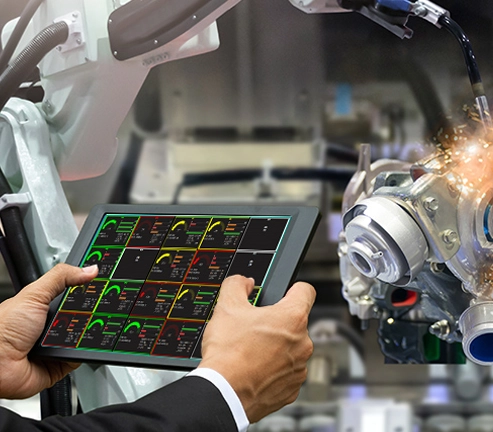


DIGITALIZATION OF PRODUCTION ACTIVITY
Manage and automate production with high-performance solutions
SOFTWARE FOR PRODUCTION
How do Senior Software solutions support digitalization in production?
In the factory, digitalization makes it possible to collect and analyze data through machines and leads to faster, more flexible and more efficient processes, so that high quality goods are produced at low costs.
Thus, with the help of a suite of software systems dedicated to production management, companies can achieve:
- Feasible production planning, correlated with available resources
- Short execution time and non-fragmented workflows
- Complete traceability for raw materials and finished products
- Real-time visibility of orders and processes
- Control costs and accurate calculation of production prices
2
EFFICIENCY4
COMPETITIVENESS1
ORGANIZATION3
PRODUCTIVITATE
Clients
cpm
Complete budgeting of production activities
To obtain maximum results from their activities, manufacturing companies need to have full control over costs and budgets, the ability to forecast future results and the capacity to easily compare different scenarios. This is why analytics and budgeting solutions have become increasingly useful for manufacturing companies, allowing them to plan in detail:
- Costs of raw materials and supplies
- Consumption estimates, based on sales forecast
- Estimates for labor and human resources
- Purchases, based on sales and production recipes
aps
Optimal production order planning
In the area of production planning, a high-performance solution will provide the organization with information about what to produce, when to produce, on which equipment and with which resources. Through advanced calculation algorithms, the system takes into account the entire production activity, from existing operations and resources to the need for raw materials or maintenance activities, thus providing a balance between the company’s production capacity and customer demand. In addition:
- Takes into account the finite or infinite capacity of the production unit
- Automatically generates plans according to certain algorithms
- Displays the planning in the form of a Gantt chart
- Allows regeneration of the planning in just a few seconds
- Allows comparison of different planning scenarios
INTEGRATED FLOWS
Execution of production-specific operations
Our solutions successfully cover all production operations, providing total control over the operations performed and enabling the implementation of well-defined workflows that will facilitate the automation of activities.
Integrates the offer process into the production flow
The system allows you to optimize each stage, from offer to actual production execution, regardless of the complexity of the project or the volume of orders.
Features
- Set up offer flows, depending on the type of production
- Define configurable products and prototypes (Configurator)
- Manage matrix items with multiple attributes
- Create and generate project-type offers
- Save and reuse offers from customer history
- Automatic offer configuration based on customer requirements
- Revision control and alternative offer versions
- Automatic validation and internal approval flow
Anticipate demand and increase production efficiency
Once accepted, sales quotes can be quickly converted into firm orders, ensuring a smooth transition between sales and production and providing full control over customer demands.
Features
- Generate demand forecasts at customer level
- Create the master production plan at organization level
- Enter orders (manually, import from online store or from offer)
- Ability to enter CTP (Capable to Promise) orders
- Validate stock and available terms at the time of registration
- Convert requests into sales or production orders
- Complete reporting on the evolution of requests and orders
- Automatic approval or configurable flows
Centrally manage production orders
Production orders can be manually added to an ERP system, can be automatically generated from sales orders or can be created using an MRP module.
Features
- Create orders based on sales estimates or actual requests
- Automatic generation through MRP, depending on material requirements
- Create orders from previous configurations, with quick adjustments
- Automatic association with recipes, stages and production resources
- Validate the availability of materials and capacities before launch
- Real-time tracking of progress and resource consumption
- Calculate costs and deviations by phases and materials
- Integration with financial, inventory and procurement modules
Increase production performance through intelligent planning
Optimal production planning aims to coordinate key processes such as demand, forecasting, operations scheduling, material planning and production capacity.
Features
- Production planning by days, weeks, months or any combination
- Define plans at the recipe, stage or finished product level
- Multi-constraint scheduling based on orders
- Production planning on stock or to order
- CTP (Capable to Promise) planning features
- Integration with inventory and purchasing modules
- Simulation of alternative scenarios for the production plan
- Monitoring the degree of loading
Eliminate waste through efficient material planning
Constantly ensuring product quality is essential for the success of the organization, and this requires rigorous control at every stage of the production process.
Features
- Determining raw material requirements based on the production plan
- Correlating material requests with manufacturing orders and recipes
- Visual or instrumental quality testing
- Quality control of manufacturing processes
- Manual or automatic recording of quality test results
- Management of scrap and non-conformities
Maintain quality standards and eliminate losses
The rework process involves correcting non-conforming products following quality inspections, thus ensuring the maintenance of a high standard of production and reducing losses.
Features
- Identifying non-conforming products following quality inspections
- Re-introducing non-conforming products into production
- Monitoring the traceability of rework products
- Automatically generating rework orders
- Analyzing the causes of non-conformities and optimizing processes
- Recording rework results and updating related stocks
- Reporting costs, times and resources consumed for rework
- Optimizing manufacturing processes to prevent non-conformities
Optimize maintenance for uninterrupted production
The profitability of a manufacturing company depends on the proper functioning of the factory equipment, preventing unplanned shutdowns and reducing maintenance costs.
Features
- Monitoring the status of equipment and informing staff about them
- Automatic planning of interventions after operating hours or alerts
- Managing activities of different types: predictive, preventive, corrective or autonomous
- Coordination of operations without interrupting production activities
- Generating maintenance orders with allocation of resources and parts
- Tracking the history of interventions and related costs
MES
Improving communication in the factory
Automated production is based on an integrated system of equipment, machines, people, mobile devices and software systems. Digitalization solutions make it possible to unify and connect resources, by:
- Connection to equipment
- Communication with staff
- Data capture
- Complete traceability
- End-to-end workflows

- Raw material costs
- Consumption forecasting, based on sales forecast
- Labor and human resource estimates
- Purchases, based on sales and production recipes

- Implementation of predefined workflows for activities in the production section
- Transmission of documentation and procedures in digital format

- Activity can be clocked in by scanning or manually entering into a mobile device
- An approval system can be implemented, which eliminates human errors
- Materials are checked for conformity upon receipt
- Handling units are generated in which the products will be stored
- Replenishment activities can be performed manually or automatically
- Available stocks are displayed in real time

- Automatic identification of product batches and their relationship to raw materials and packaging
- Complete traceability, both upstream and downstream, to track the flow of materials and products throughout the production chain
- Automatic allocation of batches in production, optimizing the process and reducing the risk of error

- Traditional production, or based on customer orders
- Production of unique items and small series
- Project-based production

BUSINESS INTELLIGENCE
Reporting and monitoring production activities
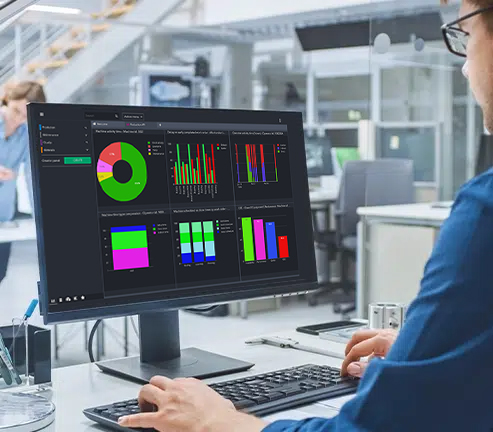
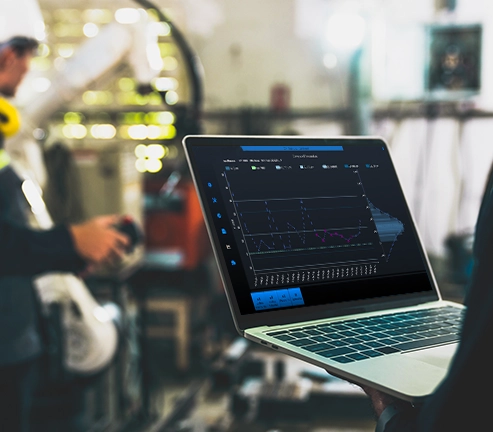
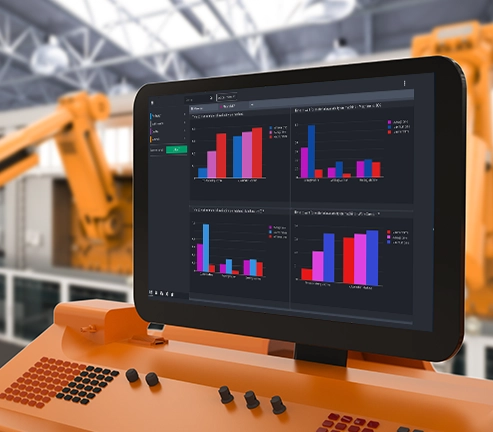
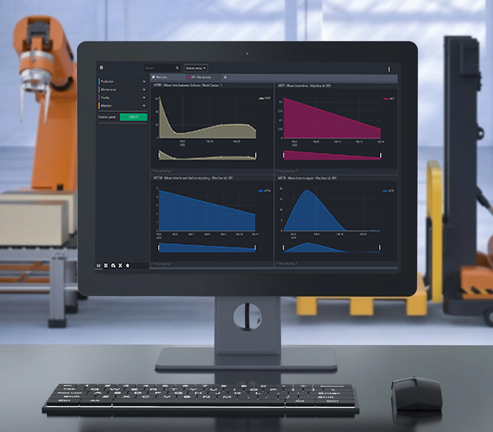
When it comes to production data reporting, we offer modern solutions that successfully extract information from the systems used within the company and display it in an interactive format for easy interpretation. This way, you can obtain essential information for performance improvement and decision-making:
- Comparisons between final and anticipated costs
- Performance monitoring: forecasts, budget analysis, what-if simulations
- Automatic allocation of indirect expenses by cost center (percentages of sales, number of employees, allocated space, machine operating hours)
- Calculation of production cost components and monitoring of their share in the final cost (raw materials, labor, packaging, etc.)
- Estimation of production supply requirements based on quantitative budgeting of finished products
- Profitability analysis of profit centers, departments, sub-departments, activities, orders, and products